A Heartbeat Away: Rhode Island’s Overlooked Race Deserves Pawtucket’s Attention

With Sabina Matos and John Loughlin virtually tied, voters face a consequential choice about affordability, accountability and who would be ready to become governor.

The race for governor may command the headlines, but another statewide contest deserves a closer look.

Rhode Island’s lieutenant governor race has become one of the most competitive contests of the 2026 election. An Emerson College Polling/WPRI survey released October 13 found Republican challenger John Loughlin at 45% and Democratic incumbent Sabina Matos at 44%. The survey of 800 likely voters, conducted October 8–11, had a credibility interval of plus or minus 3.5 percentage points. That makes this a statistical tie, with neither candidate holding a clear advantage.

For Pawtucket voters, this contest deserves more than a quick glance at the party labels.

The lieutenant governor is, quite literally, a heartbeat away from the governorship. Rhode Island’s Constitution places the officeholder next in line when the governor’s office becomes vacant because of death, resignation, impeachment or inability to serve. Voters are choosing someone who must be prepared to assume the state’s highest office.

Sabina Matos: Affordability, housing and experience

Matos, a former Providence City Council president, became lieutenant governor in 2021 and won a full term in 2022. Her argument for reelection centers on using the office to respond to everyday concerns, particularly grocery access and housing.

One of her most concrete accomplishments involves restrictions that prevent competing supermarkets from occupying former grocery store properties. Matos advocated for legislation prohibiting new restrictions of that kind and says her next goal is addressing restrictions already in place. The idea is to remove a barrier that can leave neighborhoods struggling to attract another supermarket after one closes.

For Pawtucket, the potential relevance is straightforward: families benefit when they have practical choices about where to buy food. Removing barriers to supermarket competition could help communities attract stores, although a legal change alone cannot guarantee a new location or lower prices at the checkout.

Matos also supports increasing housing construction. In an October 14 interview with Ocean State Media, she said she does not support statewide rent stabilization, expressing doubt about its effectiveness and emphasizing the need to build more housing. Her campaign also identifies reproductive freedom and voting rights as priorities.

That distinction matters for Pawtucket renters. Supporting affordable housing does not automatically mean supporting limits on rent increases. Matos’ approach raises a practical question: how quickly can additional construction help people whose rent is already stretching their budgets?

Where Matos deserves scrutiny

Matos’ record includes a serious controversy: fraudulent nomination signatures connected to her unsuccessful 2023 congressional campaign. Two campaign workers ultimately received probationary sentences. Matos herself was never charged and maintained her innocence.

Those facts should be stated together. The scandal does not establish that Matos personally committed fraud. It does, however, leave voters with a legitimate question about campaign supervision and the judgment used in selecting and overseeing people working on her behalf.

Her response to the Washington Bridge crisis also deserves examination. Matos recently explained that she opposed removing Transportation Director Peter Alviti in the middle of the crisis, while saying she believed he eventually needed to leave. Voters can reasonably debate whether that represented stability during an emergency or insufficient urgency about accountability.

As the incumbent, Matos also carries the burden of demonstrating results. Her grocery legislation is tangible, but residents are entitled to ask how her broader advocacy translates into measurable improvements in housing access and household affordability.

John Loughlin: Energy costs and a stronger watchdog role

Loughlin brings a different background: former state representative, Army veteran and longtime WPRO radio host. He argues that the lieutenant governor’s office has been underused and could play a more forceful role in shaping policy and challenging the political establishment.

Energy affordability is a central campaign issue. Loughlin supports expanding access to natural gas pipeline capacity as a way to obtain cheaper domestic gas. His campaign website makes an ambitious claim that his plan could cut electric bills in half. That is a campaign promise, rather than an established outcome.

For Pawtucket households and businesses, meaningful energy savings could free up money for other necessities, payroll or investment. But the details matter: what infrastructure would be needed, who would pay for it, how long would it take, and how much of any savings would reach customers?

Loughlin also emphasizes government oversight. He has claimed that his public push for an inspector general helped move lawmakers toward creating that office. Matos disputes his claim to credit, noting that the proposal had been discussed for years. The sequence of events does not, by itself, establish that his intervention caused the legislation to pass.

On housing, Loughlin opposes rent control, arguing that it discourages investment and construction. He also presents Republican representation in statewide office as a way to introduce more competition into a government dominated by Democrats.

Where Loughlin deserves scrutiny

Loughlin’s energy promise deserves particularly careful questioning. A pledge to cut electric bills in half is attractive, but voters should demand a clear timetable, cost estimates and evidence supporting that level of savings. The lieutenant governor would also need cooperation from officials and institutions beyond the office to advance major infrastructure changes.

His criticism of rent control presents another challenge: even if additional construction improves the housing market over time, what should happen to renters who need help immediately? Pawtucket voters should expect an answer that addresses both future supply and present hardship.

His language can also be polarizing. In his October 14 Ocean State Media interview, Loughlin characterized Matos’ support for linking electric payments to income as “classic Marxism.” That rhetoric may appeal to some voters, but it invites a fair question about whether he would approach disagreements through practical negotiation or ideological confrontation.

Independence can be valuable. Its effectiveness depends on the ability to turn criticism into agreements and results.

What could either candidate actually do for Pawtucket?

The office has meaningful responsibilities, but its powers have limits. Rhode Island’s budget documents describe a role involving legislative advocacy, assistance connecting residents with agencies, and leadership in areas including small business, emergency management and long-term care. The lieutenant governor cannot independently enact housing laws, set utility rates or direct every state agency.

That makes the candidates’ working styles especially important.

Matos offers current experience in the office and a focus on consumer access and housing. Loughlin offers a challenge to existing leadership, with energy costs and oversight at the center of his campaign. Both should be asked to explain what they would deliver for Pawtucket, how they would measure success, and how they would work with a governor who disagreed with them.

Neither should receive a free pass because of a party label. Neither should be judged solely by a controversy or an applause line.

With Election Day approaching on November 3, this close race presents an opportunity to look beyond the most heavily advertised contests and examine the person waiting next in line.

Before casting that vote, ask yourself: If the next governor could no longer serve, would I trust this candidate to lead Rhode Island tomorrow—and have I paid enough attention to know why?

Pro Football Is Coming to Pawtucket in 2027

PAWTUCKET, R.I. — Professional spring football is headed to Pawtucket. The United Football League announced Wednesday that a new Rhode Island team will begin play in 2027, calling Centreville Bank Stadium its home.

The team’s inaugural home game is scheduled for Friday, April 2, 2027, at 8 p.m. The game will be broadcast nationally on FOX as part of FOX UFL Friday.

Fans won’t have to wait until next spring to learn what to call the team. The UFL plans to unveil its name, colors and logo at a public celebration at Centreville Bank Stadium on October 18. Season ticket deposits will also be available at the event.

The announcement adds another major sporting event to the downtown stadium’s calendar. Opened in 2025 as the home of Rhode Island FC, Centreville Bank Stadium has also hosted college football and other sports. Now, it is set to welcome a professional football team with a Rhode Island identity.

Centreville Bank Stadium General Manager Paul Byrne called the arrival of professional football “another exciting milestone” for the venue and the state.

Rhode Island is one of two markets joining the UFL in 2027, alongside Colorado. Utah and Oklahoma are scheduled to follow in 2028, bringing the league to 10 teams.

For Pawtucket sports fans, the next date to circle is October 18, when the city will get its first look at the team that will take the field next spring.

SPORTS

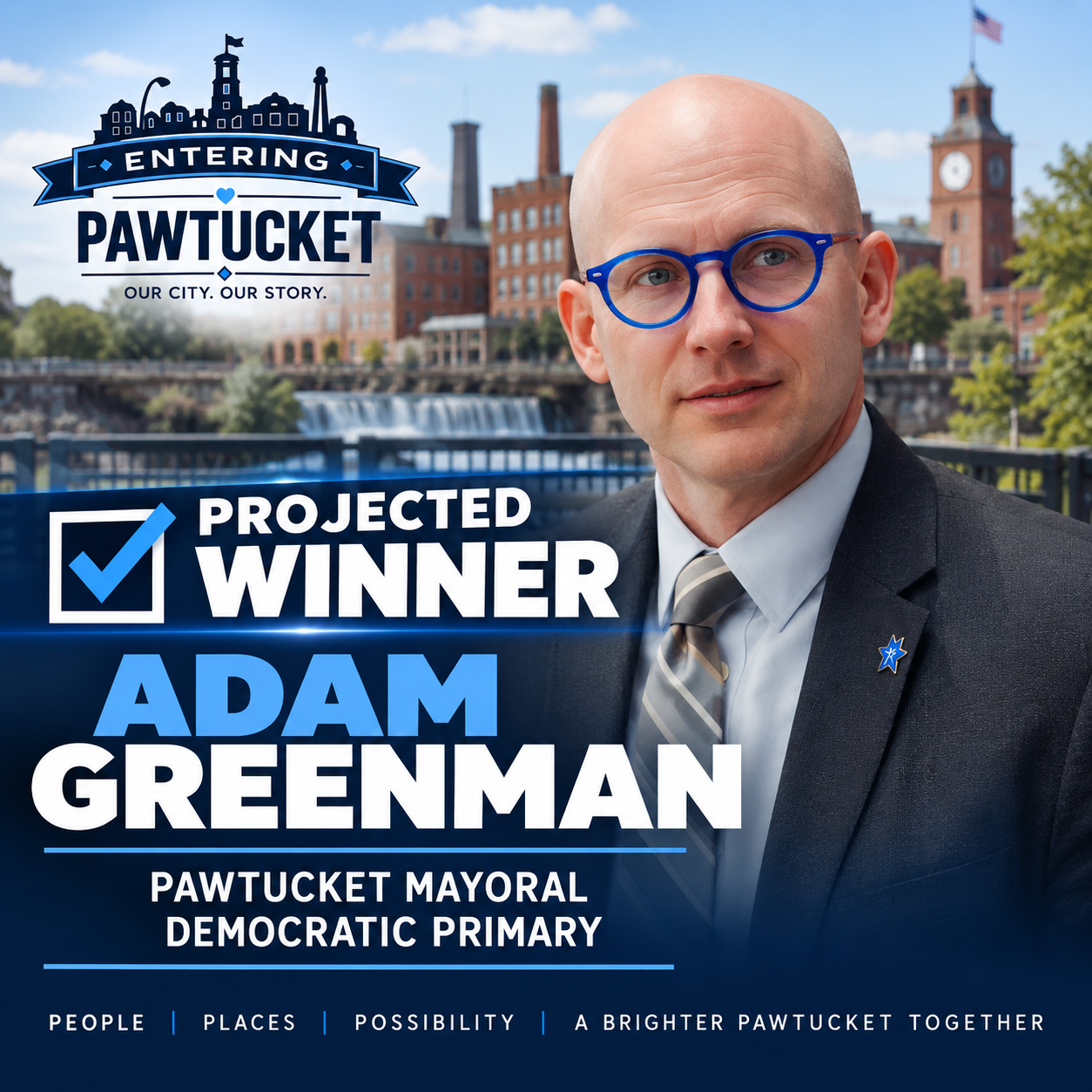
BREAKING: Adam Greenman Projected Winner of Pawtucket Mayoral Democratic Primary

PAWTUCKET, RI — Adam Greenman is the projected winner of the Democratic Primary for Mayor of Pawtucket, defeating longtime incumbent Mayor Donald Grebien.

The projected victory marks a major shift in Pawtucket politics, with Greenman defeating Grebien after a campaign centered on change, accountability, public safety, housing, education, economic development, and the overall quality of life in the city.

Grebien has served as Pawtucket’s mayor since 2011, making tonight’s projected result a significant moment for the city and its political future.

Greenman will now move forward following his Democratic Primary victory as Pawtucket prepares for the next chapter in the 2026 election.

Entering Pawtucket will continue to follow the results and bring you updates, reaction, and additional coverage as more information becomes available.

This is a developing story. Results remain unofficial until certified by election officials.

Entering Pawtucket — Our City. Our Story.

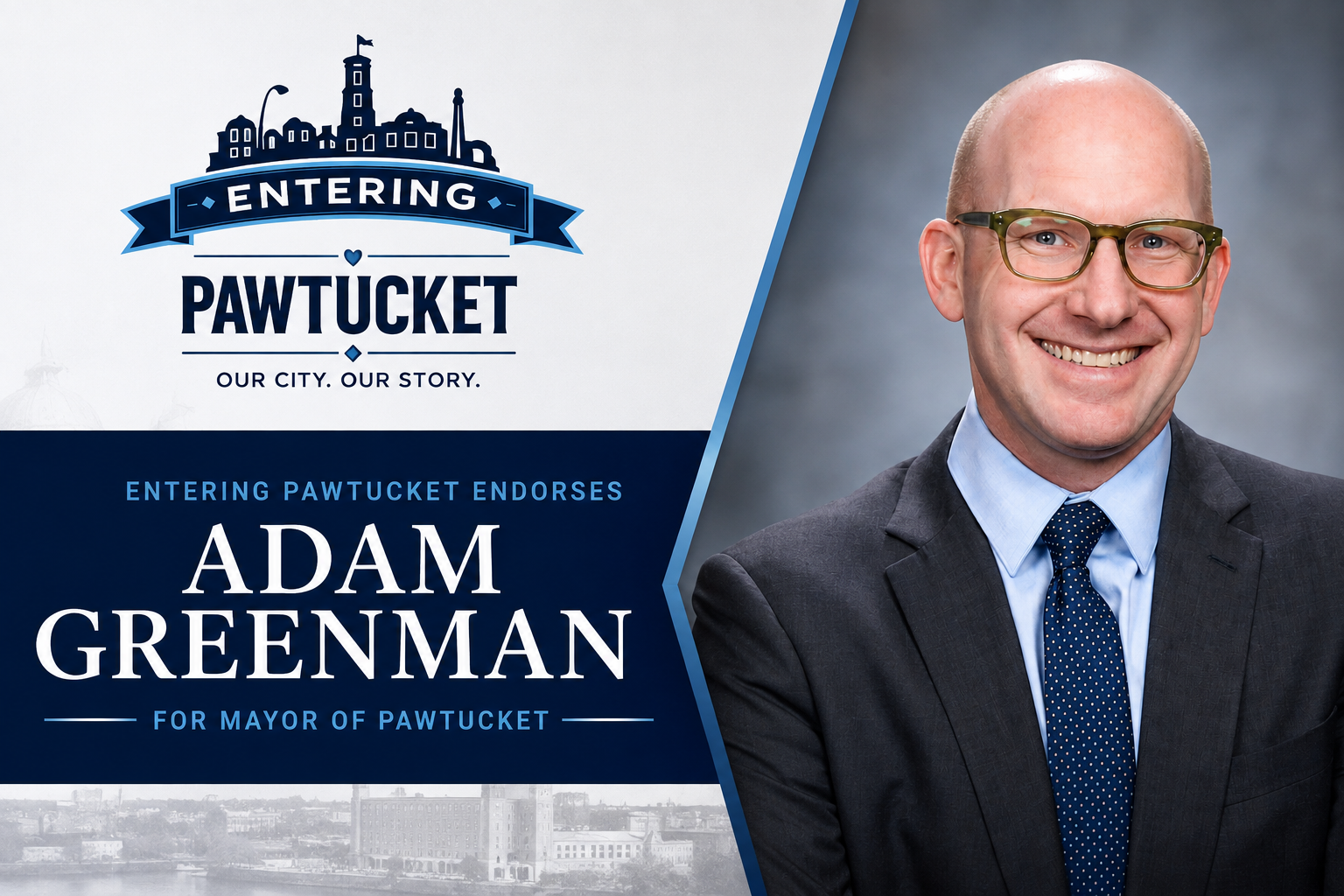
ENTERING PAWTUCKET ENDORSES ADAM GREENMAN FOR MAYOR OF PAWTUCKET

August 13, 2026 After speaking with both candidates in great detail, asking questions, listening carefully to their ideas, and considering their respective visions and direction for the future of Pawtucket, Entering Pawtucket has decided to endorse Adam Greenman for Mayor of Pawtucket.

Read Why


Pawtucket News & More

Links

Culinary Pawtucket


Top 5 International Restaurants in Pawtucket

Around Pawtucket

A Day of Pawtucket Pride! 🏀 Community, Culture, Food & Giving Back 🙏🏽

A Drive Around Pawtucket, Rhode Island | 4K Hyperlapse Video


📢 SETTING THE RECORD STRAIGHT: JOHN STREET COMMUNITY DAY

Filming the movie “Rubber Hut” at Veteran’s Pool

Got A Tip or Suggestion?

Have a tip? Or see something happening in Pawtucket? Help us keep the community informed. Send us your news tips, photos, or videos about breaking news, community events, or anything residents should know about. Your information helps Entering Pawtucket share important local stories with the community.

Follow us on the Socials